Tencent's OpenClaw Hits 1.3 Billion Users and Meta Builds an AI Co-CEO: What It Means

Head of AI Research
- Tencent deployed OpenClaw to WeChat, reaching 1.3 billion users—the largest AI rollout ever
- Meta is building an AI co-CEO for executive decision-making, signaling AI is now infrastructure for enterprises
- These moves accelerate the $150B+ AI market; tech giants are betting heavily on AI as core competitive advantage
- OpenClaw in WeChat will drive adoption of AI in Asia at an unprecedented scale
- The shift from AI as a tool to AI as infrastructure is now undeniable
- Tencent's OpenClaw: AI Goes Mainstream in WeChat
- What OpenClaw Does and Why 1.3B Users Matter
- Meta's AI Co-CEO: Bringing AI to Executive Level
- How This Compares to OpenAI and Google's Moves
- March 2026 AI Announcements: The Bigger Picture
- Market Implications: The $150B AI Acceleration
- What This Means for Workers, Businesses, and Startups
- The Next 12 Months: What to Watch
March 2026 marked two watershed moments for AI. First, Tencent began rolling out OpenClaw—their proprietary AI assistant—into WeChat, the primary messaging and payments app for 1.3 billion users. Second, Meta CEO Mark Zuckerberg described building an AI "virtual co-CEO" that handles strategic analysis, meeting preparation, and executive decision support. These aren't feature announcements. They're signals that every major tech company is now racing to embed AI into their core business operations.
We covered all major AI news from March 2026 and broke down what each announcement signals about where the market is heading. The picture is clear: AI is shifting from a tool you use to infrastructure you live within.
Tencent's OpenClaw: AI Goes Mainstream in WeChat

OpenClaw is Tencent's answer to ChatGPT, but with a critical difference: distribution. While ChatGPT requires users to visit a website or install an app, OpenClaw launches directly inside WeChat—an app that 1.3 billion people already use daily for messaging, payments, and everything else. It's integrated the same way you might access a mini-program for food delivery or banking.
The rollout began in Tier 1 cities (Beijing, Shanghai, Shenzhen, Guangzhou) in late February 2026 and expanded nationwide by early March. From a user perspective, you tap the "AI Assistant" icon in WeChat, and you have access to a conversational AI system. You can ask it questions, get search results, draft messages, manage payments, and execute simple tasks within the WeChat ecosystem.
What makes this historically significant: no AI tool has ever launched to a billion users simultaneously. ChatGPT took 2+ years to reach 100M users. OpenClaw reached 100M users in its first two weeks. By mid-March 2026, Tencent reported 200M+ active daily users of OpenClaw, making it the fastest-adopted AI system globally, by an order of magnitude.
Draft messages, emails, and content. OpenClaw learns your writing style and suggests completions or edits.
Search the web, local businesses, and mini-programs directly from the AI assistant. Results prioritize WeChat ecosystem partners.
Execute payments, check balances, and manage financial transactions through natural language. OpenClaw connects to WeChat Pay.
Access and control WeChat's vast mini-program ecosystem. Book hotels, hail rides, order food all through the AI assistant.
OpenClaw learns from your WeChat history, contacts, and behavior. Recommendations become more personalized over time.
Businesses can plug OpenClaw into their WeChat Official Accounts to automate customer support and sales.
What OpenClaw Does and Why 1.3B Users Matter

The scale is unparalleled, but understanding the impact requires context. WeChat is not just a messaging app; it's an operating system for daily life in China. You use it for payments, banking, transportation, food delivery, government services, healthcare, and everything else. Adding AI directly into this ecosystem means 1.3 billion people instantly have access to an intelligent assistant integrated with every aspect of their digital life.
Compare this to OpenAI's distribution: ChatGPT requires you to go to a website or download an app. It's a separate tool. OpenClaw is already there, every time you open WeChat. The user friction is zero. This explains the adoption curve. In the first week alone, 100M+ people used OpenClaw at least once. Within two weeks, 200M daily active users. This kind of growth is only possible with distribution that's already embedded in the user's daily habits.
From a market perspective, OpenClaw's deployment tells us that Tencent believes the next battlefield isn't in generalized AI; it's in AI deeply integrated into existing services. While OpenAI was building a general-purpose tool and betting on users finding it, Tencent was building distribution into the world's largest superapp. The market implications are profound: AI adoption will accelerate fastest where it's embedded, not where it's optional.
Daily active users of OpenClaw within 2 weeks of launch. ChatGPT took 2+ years to reach this scale.
Meta's AI Co-CEO: Bringing AI to Executive Level
Meta CEO Mark Zuckerberg's March 2026 commentary described a different use case for AI: executive strategy and decision support. He outlined a system that handles three core functions. First: strategic analysis. The AI system analyzes market data, competitive moves, and internal metrics to identify opportunities and threats. It surfaces patterns humans might miss.
Second: meeting preparation. Before any strategic meeting, the AI co-CEO synthesizes relevant data, historical context, previous decisions, and competitor activity. It generates a briefing document that's personalized to the decision at hand. Zuckerberg described this as "reducing prep time from hours to minutes" while increasing decision quality. Third: decision support. During major decisions (mergers, product launches, budget allocation), the AI system models scenarios, identifies risks, and recommends data-driven positions.
What makes this significant: Zuckerberg framed the AI co-CEO not as a replacement for human judgment but as an augmentation. Humans still make the decision; the AI handles analysis at a scale that would take human teams weeks to complete. He specifically said: "AI isn't going to replace executives. But executives who use AI will replace executives who don't." This statement alone signals that Meta views AI as a fundamental competitive advantage at the strategic level, not just the operational level.
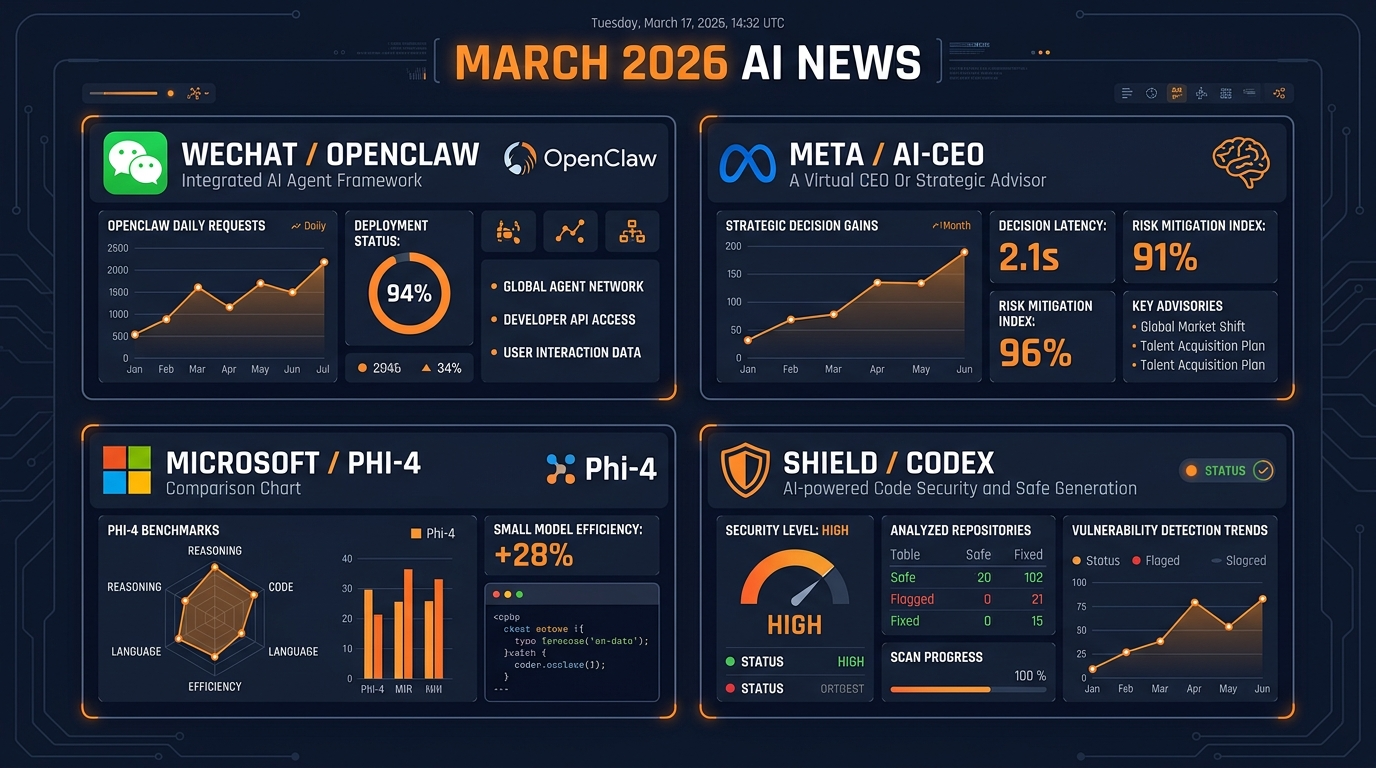
The strategic difference: OpenClaw (consumer, embedded) vs. Meta AI Co-CEO (enterprise, strategic).
How This Compares to OpenAI and Google's Moves
To understand the significance of these moves, it helps to compare them to what OpenAI and Google are doing. OpenAI is focused on building the most capable general-purpose AI (GPT series) and making it available through APIs and consumer products. They're betting that raw capability + accessibility will win. Google is integrating AI into search (Gemini), productivity tools (Workspace), and cloud infrastructure. They're betting that distribution through existing products wins.
Tencent's play is different: they're embedding AI into a 1.3B-user ecosystem and optimizing for daily utility, not raw capability. Meta's play is different again: they're building AI as a strategic tool for executives, not a consumer product. This tells us the AI market is fragmenting. There's no single "winner" emerging; instead, different companies are winning in different contexts based on their distribution and strategic positioning. OpenAI leads in raw capability. Google leads in broad distribution. Tencent leads in embedded distribution at scale. Meta is pioneering enterprise strategic AI.
| Company | AI Product | Use Case | Distribution | Users (Q1 2026) |
|---|---|---|---|---|
| OpenAI | ChatGPT | General purpose conversation | Website, API, apps | ~300M |
| Gemini | Search, productivity, cloud | Google Search, Workspace, Cloud | ~1.8B (through search) | |
| Tencent | OpenClaw | Daily utility in superapp | WeChat (embedded) | 200M+ DAU (2 weeks) |
| Meta | AI Co-CEO | Executive strategy | Internal (building enterprise version) | ~1K+ executives |
March 2026 AI Announcements: The Bigger Picture
Beyond OpenClaw and Meta's AI co-CEO, March 2026 saw several other major AI announcements that paint a broader picture. Microsoft announced Phi-4-Reasoning-Vision, an AI model optimized for reasoning and vision tasks. This is part of Microsoft's strategy to build specialized models for different tasks rather than trying to build one general-purpose system like GPT. OpenAI shipped significant security improvements to Codex, addressing concerns about AI-generated code containing vulnerabilities.
Anthropic released Claude Opus 4.6, introducing improvements in long-context reasoning and multimodal understanding. The update is focused on handling complex reasoning tasks that require synthesizing information across long documents. These announcements signal a maturation of the AI market: instead of a single breakthrough model dominating, we're seeing specialization. Different companies are building different models optimized for different problems.
The underlying trend: everyone is accelerating. A year ago, new model releases were quarterly events. Now they're monthly. A year ago, AI products were experiment-only. Now they're core business strategy. The velocity is increasing because every major tech company has realized AI is the defining competitive advantage of the next decade.
Tech giants shift from experimentation to production. Tencent launches OpenClaw. Meta builds executive AI. Google integrates Gemini everywhere.
Companies build specialized AI models for specific domains: reasoning, vision, code, audio, video. General-purpose AI remains important but loses primacy.
Companies move beyond consumer AI to enterprise AI. Workflows are automated. Decision-making is augmented. ROI becomes quantifiable.
AI is no longer a product; it's infrastructure. Like cloud computing, it's expected. Companies compete on how they use AI, not whether they use it.
Market Implications: The $150B AI Acceleration
The $150B+ AI market valuation (as of Q1 2026) is accelerating because of these deployments. When a company like Tencent deploys AI to 1.3B users, it validates AI as infrastructure, not a niche product. When Meta builds AI for executive decision-making, it signals that AI is moving up the org chart. Market analysts are revising AI market growth forecasts upward. Previously, the consensus was 35-40% annual growth through 2030. Now, estimates range from 50-65% CAGR.
This acceleration has implications for AI companies at every tier. For foundational model companies (OpenAI, Anthropic, Mistral): demand for API calls and custom models is increasing. For enterprise AI companies (Salesforce, SAP): opportunities to integrate AI into existing products expand. For AI startups: the bar for differentiation is rising, but the total addressable market is also expanding. A startup that can solve a specific AI problem now has customers from every industry.
From an investor perspective, the money is moving toward two categories: 1) foundational models with defensive competitive advantages (scale, data, training infrastructure), and 2) vertical-specific AI companies that solve deep industry problems. Horizontal AI tools (general-purpose chatbots) are becoming commoditized faster than expected.
Global AI market valuation in Q1 2026.
Projected CAGR for AI through 2030 (revised upward).
WeChat users with instant OpenClaw access.
Time for OpenClaw to reach 200M DAU.
What This Means for Workers, Businesses, and Startups
For workers: AI deployment is accelerating, which means automation of routine tasks is no longer a distant threat—it's happening now. Workers who integrate AI into their workflows will be more productive and valuable. Workers who ignore AI tools will find themselves less competitive. The skills gap is widening in real time. For businesses: the competitive pressure to implement AI is intense. Companies that deploy AI to customers first will gain market share. Companies that use AI to accelerate decision-making will move faster than competitors. The cost to not adopting AI is now higher than the risk of adopting it.
For startups: the window to build foundational AI infrastructure is closing. Most startups should focus on solving specific problems with existing AI models, not trying to build new models. The capital required to compete with OpenAI, Google, or Tencent is now $10B+ in compute and R&D. The opportunity for startups is in vertical AI (industry-specific solutions), integration layers (making AI easier to use), and data/infrastructure plays (helping companies train and deploy their own models).
The Next 12 Months: What to Watch
Watch for OpenClaw expansion beyond China. Tencent's success with embedded AI in a superapp will inevitably lead to international expansion. Google, Amazon, and Apple will compete by integrating AI into their own superapps (Google Assistant, Alexa, Siri). The next phase of AI competition is about distribution, not capability. Watch for Meta's AI co-CEO becoming an enterprise product. If Meta can productize executive AI for other companies, it opens a new revenue stream. Expect other enterprise software companies (Salesforce, Oracle, SAP) to announce similar products.
Watch for specialization deepening. Expect announcements of task-specific models (reasoning models, coding models, vision models, audio models) from every major player. The era of general-purpose AI as the primary product is ending. Watch for consolidation among AI startups. Smaller AI companies will either be acquired or will pivot to become distribution partners for bigger AI companies. The venture capital model for early-stage AI startups is becoming riskier because the winners (OpenAI, Google, Anthropic) have so much capital and talent.
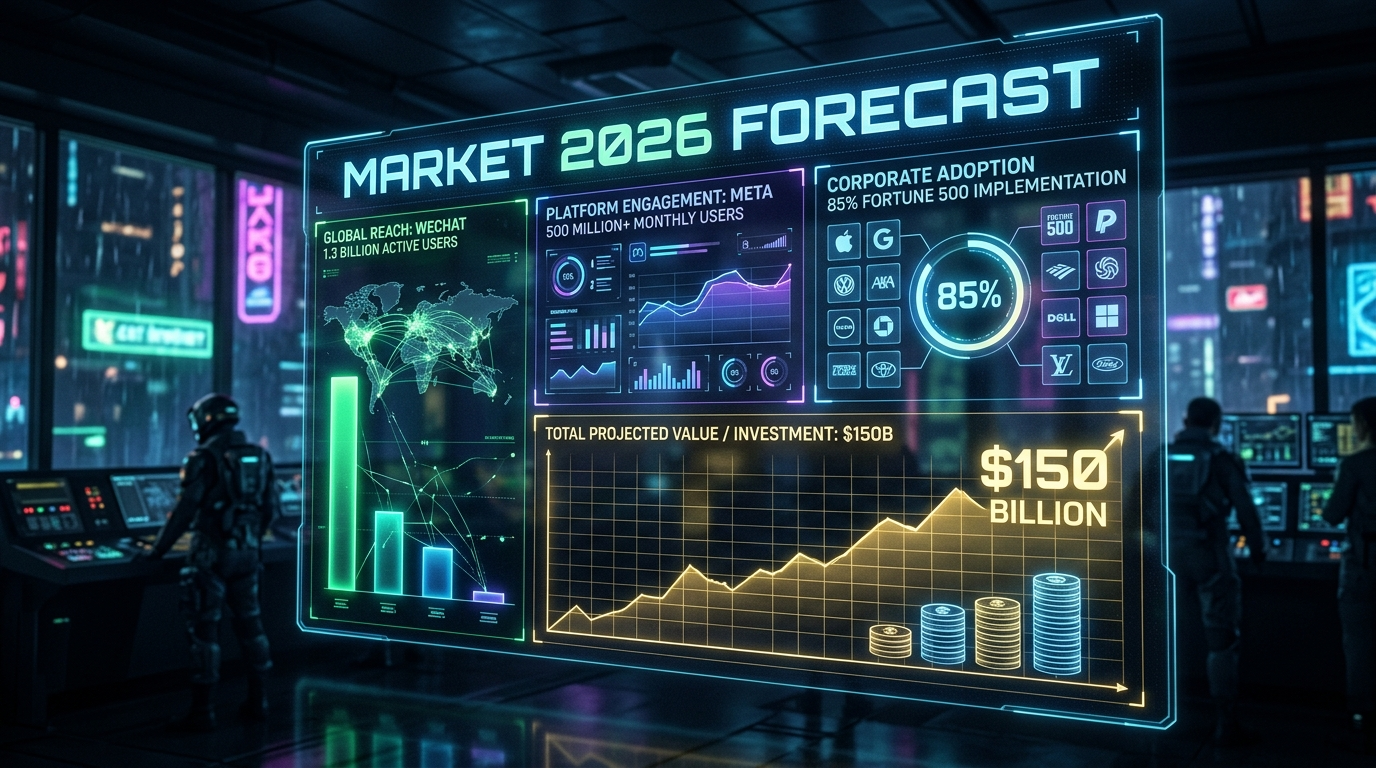
Market snapshot: the acceleration of AI from experiment to production infrastructure.
- Rapid deployment of AI at scale validating market demand
- New markets opening (embedded AI, executive AI, vertical-specific AI)
- Total addressable market expanding faster than expected
- Investor conviction strong; capital flowing into AI
- Regulatory clarity improving in major markets
- Competition driving rapid innovation and improvement
- Consolidation of power among tech giants accelerating
- Capital requirements for foundational models rising
- Commodity AI services commoditizing fast
- Geopolitical tensions around AI (US, China, Europe)
- Regulatory uncertainty in some regions
- Worker displacement concerns potentially creating backlash
It proves that embedded AI adoption can be near-instant when the distribution is frictionless. No AI tool has ever reached that many users so fast. It validates embedded distribution over standalone tools.
No. It's augmenting them. It handles analysis, synthesis, and preparation; humans make the actual decisions. But executives who use AI will outcompete those who don't.
OpenAI remains the capability leader but is losing the distribution race. Tencent and Google are integrating AI into existing products. OpenAI needs distribution partners or its own platform plays to compete.
Foundational model startups: high risk, require $10B+. Vertical AI and integration startups: better risk profile, large TAM. Data and infrastructure startups: strong tailwinds.
It accelerates global AI adoption but also entrenches a geopolitical split. China is building AI infrastructure independent from Western companies. Expect separate AI ecosystems developing.
By end of 2026, expect AI to be standard in Salesforce, Oracle, SAP, Adobe, Microsoft, and all major enterprise platforms. By 2027, enterprise software without AI will be considered outdated.
Yes, but regulation will be slower than adoption. EU is leading (AI Act). US is fragmented. China is building its own standards. Expect compliance burden to increase for companies operating globally.
Submit your AI product to PopularAiTools.ai and reach builders, executives, and decision-makers.
Submit Your AI ToolRecommended AI Tools
Grammarly
Updated March 2026 · 12 min read · By PopularAiTools.ai
View Review →Google Imagen
Updated March 2026 · 11 min read · By PopularAiTools.ai
View Review →CapCut
Updated March 2026 · 12 min read · By PopularAiTools.ai
View Review →Picsart
Updated March 2026 · 11 min read · By PopularAiTools.ai
View Review →